Goal
Redefine the company's partnership model with its national network of fitness locations, shifting from a transactional vendor relationship to a strategic growth partnership that could reverse partner attrition and defend against aggressive competitors entering the market.
Research
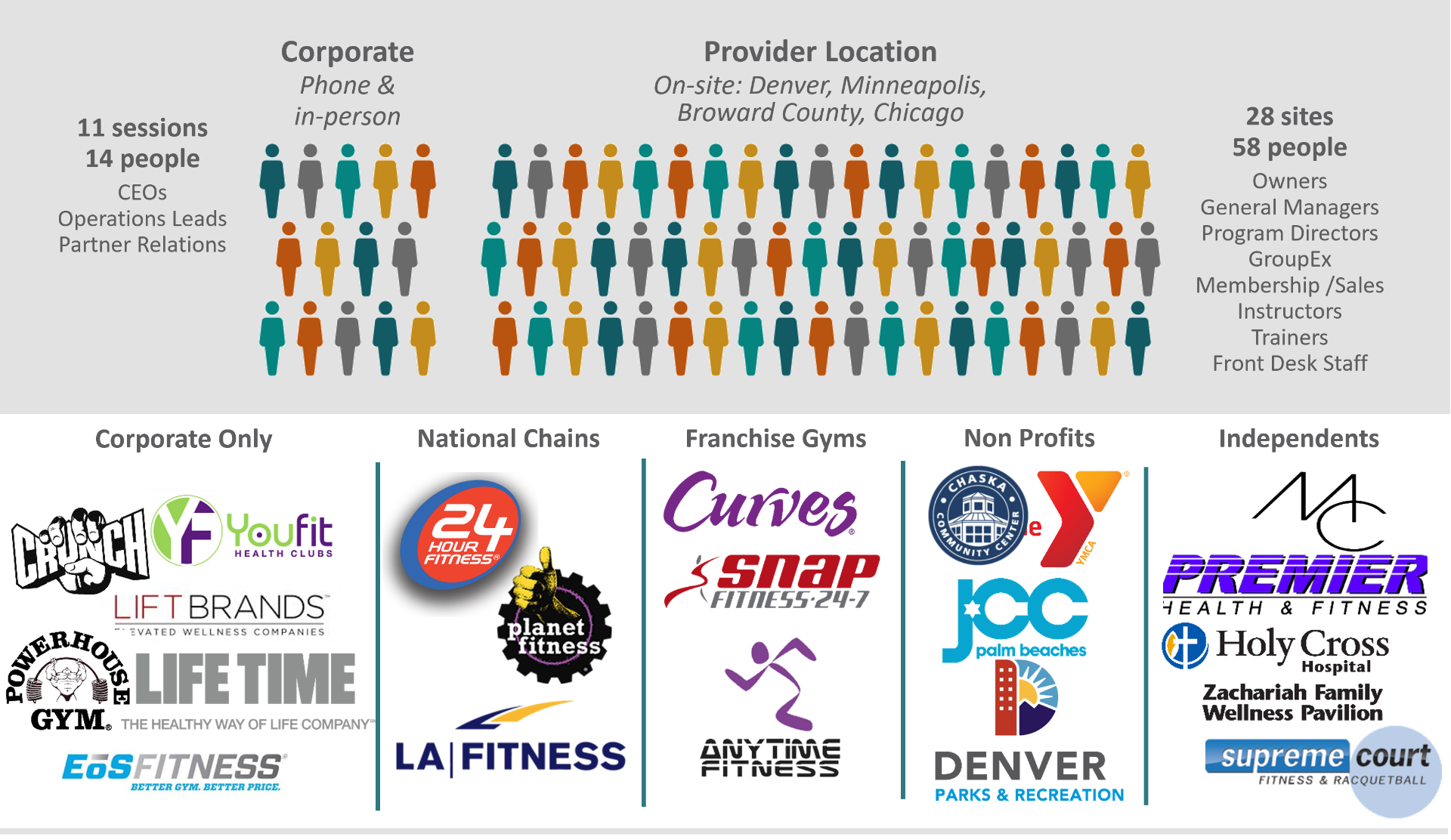
58 people across 28 fitness locations spanning national chains, franchise gyms, non-profits, and independent studios · Phone and in-person interviews · On-site observations· Corporate leadership sessions
Frameworks
Contextual inquiryAffinity mappingUser storiesTrends and Forces AnalysisBusiness model comparison

Insights
Partners valued the program's community impact deeply but the revenue model was actively driving them toward competitors offering guaranteed monthly payments instead of unpredictable per-visit fees.
A one-size-fits-all contract structure was failing across segment types: budget gyms, high-end clubs, non-profits, and independents had fundamentally different cost structures and motivations.
Partners were operating in an information vacuum, with no utilization data, no best-practice sharing, no proactive support, leaving significant engagement and revenue on the table.
"They come because their doctor told them to, they stay because they make friends."
Impact
Revenue left on the table
Partners were capturing less than a quarter of available revenue — not from lack of effort, but a structural model failure
Typical monthly earned
$9K
Monthly potential
$39K
Revenue left unclaimed
77%
Competitive threat
Competitors were winning with a fundamentally different contract — predictable, flat-fee payments that removed partner risk entirely
Pay-per-visit
$2–4
per swipe, capped 8–12
Revenue tied to attendance
Partners absorb engagement risk
Members visit multiple locations
Losing market share
Revenue guarantee
Competitor model
$27–65
flat monthly, per member
Predictable monthly income
No dependency on visit frequency
Member locked to one location
Gaining ground fast
Senior discount +
$40 + co-pay
swipe + member contribution
Member co-pay lifts engagement
Higher per-visit return
Harder to sell through insurance
Emerging alternative
Strategic response
Five challenge areas, each translated directly into a recommendation that shaped the new partnership model
Challenge area
Strategic response
Partner economics
Pay-per-visit model losing ground to guaranteed-revenue competitors
Segmented revenue model
3 contract options matched to gym type and cost structure
Eligibility friction
Check-in failures and unclear rules leave revenue unclaimed
Improved tracking
Simplified check-in, real-time eligibility status
Certification barriers
Cost, distance, and scheduling leave instructors under-qualified
Streamlined certification
Online modules, on-site hosting, community pipeline
Programming constraints
Rigid formats misaligned with member fitness levels
Diversified programming
Flexible accreditation and expanded format options
Communication gap
Partners operate without data or proactive support
Partner relations program
Utilization data, best-practice sharing, coaching
Interested in working together?
I'm open to service design roles and consulting engagements. Get in touch to start a conversation.
© 2026 Stacy Benjamin. All rights reserved.